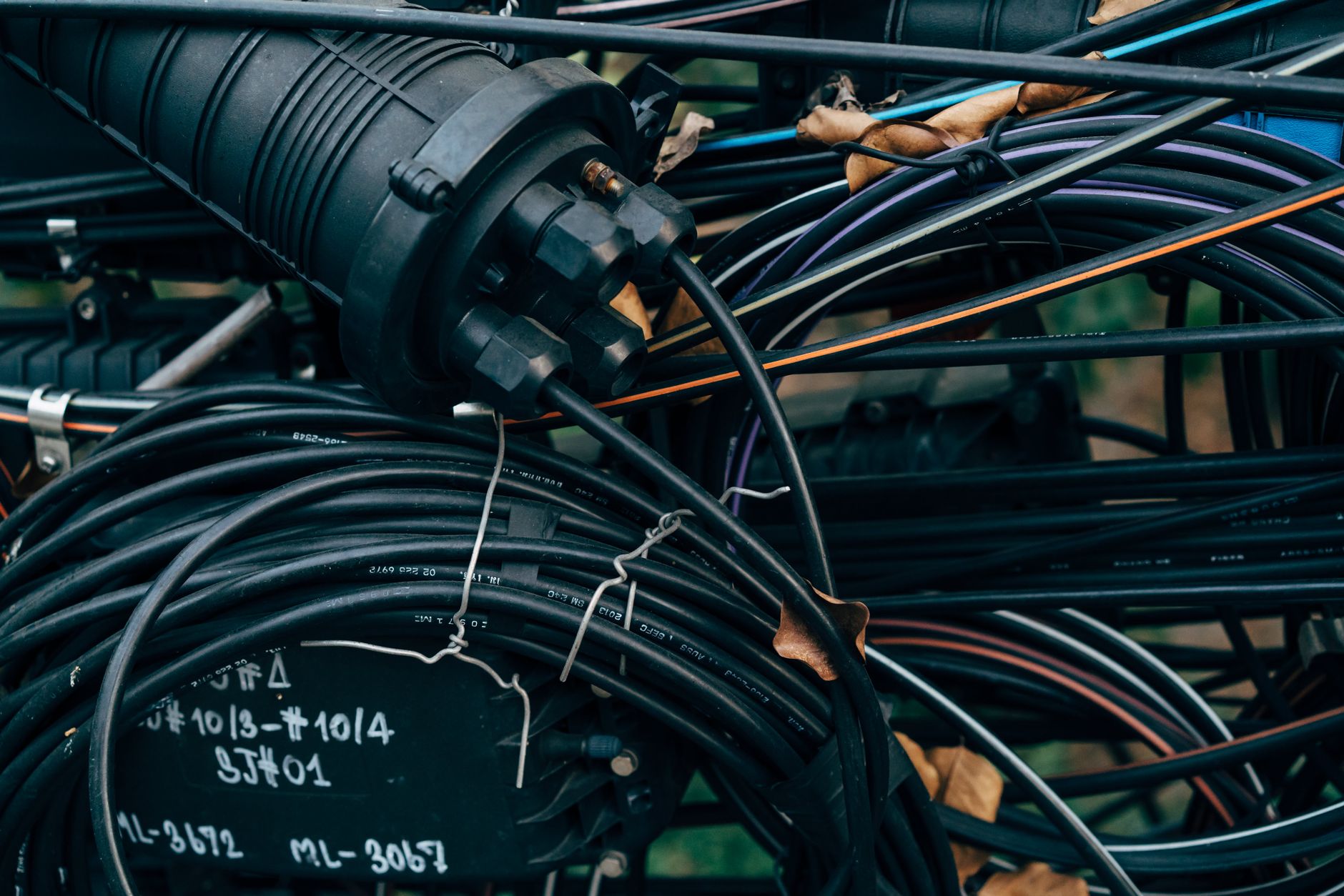
The internet is not a thing. It is a set of agreements about how computers pass small chunks of data to one another, and the enormous pile of cable, radio and machinery that carries those chunks around. No single computer holds the internet, and no organisation runs it.
When you open a web page, your device does not receive that page in one piece. It receives a few hundred numbered fragments, sent separately, quite possibly by different routes, and reassembled at your end in the right order. Almost everything else follows from that one design decision.
Packets: everything gets cut into pieces
Suppose you want to send a book to a friend, but the postal service only accepts postcards. You would copy the book onto postcards, number them, write the address on each one, and post them. Your friend waits until they all arrive, sorts them by number, and reads the book.
That is a packet. Every photo, video, message and web page moving across the internet is cut into packets of a few kilobytes, each carrying the address it is going to, the address it came from, and its position in the sequence.
This seems inefficient, and it is the reason the internet works at all. If one postcard is lost, your friend asks for that one again rather than the whole book. If one route is congested, later postcards can take a different one. Nothing depends on a clear path staying open from end to end.
Addresses and routes
Every device connected to the internet has an IP address, a number identifying it. Your laptop has one. So does the server holding this page.
Between the two sit routers. A router is a machine with several cables plugged into it and one job: look at the address on a packet, decide which cable gets it closer to that address, and pass it on. It does not know the whole route. It knows its neighbours and roughly which direction various parts of the internet lie in.
A packet from your device to a server twelve thousand kilometres away might pass through fifteen or twenty routers, each making that same small decision. There is no master map. The route emerges from a chain of local choices, which is also why the route can change halfway through without anything breaking. If you want to know what a decision procedure like that is called, it is an algorithm, and routing is one of the most consequential ones running anywhere.
What happens when you type a web address
Say you type explainly.info and press enter. Roughly this happens, in well under a second:
- The name is looked up. Routers work in numbers, not names, so your device asks the Domain Name System, the internet's address book, what number belongs to that name. It gets an IP address back.
- A connection is opened. Your device and the server exchange a short series of packets agreeing to talk. If the address starts with
https, they also agree on a shared secret so the rest of the conversation is encrypted. - A request goes out. Your browser sends, in effect, "please send me the page at this path", along with what browser you are using and what languages you read.
- The page comes back, in packets. Then the browser reads it, discovers it needs images, fonts and scripts, and repeats the whole process for each one. A single ordinary page can involve fifty or more separate round trips.
The encrypted part matters more than it sounds. Without it, every router along the way could read the contents. With it, they can still see who you are talking to, just not what you said. That distinction is exactly what a VPN changes, and what it does not.
The physical internet
For something described as a cloud, the internet is remarkably heavy.
Roughly 99 percent of intercontinental traffic travels through fibre optic cables lying on the seabed. There are several hundred of them. They are about as thick as a garden hose, they carry light rather than electricity, and they are laid and repaired by a small fleet of specialised ships. Satellites carry a small and growing share, but the sea floor still does the heavy lifting.
At each end sit data centres: warehouses of computers, air conditioning and backup power. This is where the pages, videos and models actually live. It is also why the internet has a measurable electricity bill and a real carbon footprint, and why the recent surge in demand for large language models is discussed as an energy story as much as a software one.
Who runs it
Nobody, and that is not a slogan.
Thousands of independent networks — telecoms companies, universities, governments, hosting providers — each run their own patch and agree to carry each other's traffic. Those agreements are commercial and voluntary. A handful of non-profit bodies coordinate the things that genuinely need coordinating: handing out address blocks, keeping the name system consistent, publishing the technical standards everyone follows.
Those standards are public documents anyone can read, and following them is voluntary in the sense that a network which ignores them simply stops being able to talk to anyone. The internet's coherence comes from that, not from an authority.
Why it goes wrong in the ways it does
The architecture explains most outages. A single site failing takes down one site. A large hosting provider or content delivery network failing appears to take down half the web at once, because thousands of unrelated sites were quietly depending on the same intermediary. A cut undersea cable slows a whole region until traffic reroutes. A mistake in the address book can make a working site unreachable while the site itself is perfectly healthy.
The internet is a network of networks that agree on how to pass numbered fragments of data to each other. Nothing holds the whole picture. Every part makes a small local decision, and the global behaviour is what those decisions add up to.
That is the design. It was built to survive parts of itself disappearing, and it does, which is also why it resists anyone controlling it and why it is so hard to switch off.